Switzerland: Interlaken

Before heading off to Switzerland we spent the weekend in Cambridge attending Andrew and Lila’s wedding celebration (one year after they married – Lila is from Taiwan and they married quickly last year due to visa issues) and it was a cracking party with a proper ceilidh band calling the Scottish dances. The kind of thing I would’ve completely detested as a teenager but now love. Luke and I even got in some time on the dance floor to do some rock and roll steps. Everyone had a brilliant time and I’m very glad we were there for it. Thanks, Andrew and Lila, for putting us up!

We also had a chance to play with Jeffrey, Andrew’s parents’ new puppy. He likes biting everyone and everything but was delightful nonetheless.

I also used the time in Cambridge to buy several kilos of fruit and vegetables to undo the effects of all the pizza, pasta and cheese in Italy, then made us a tub of fruit and some salad rolls to take on the plane. We have been warned by everyone that Switzerland is expensive, particularly for eating out, so I filled all the camping-equipment space in my bag with muesli, rice, pasta, tins and sauces so we can cook most of our meals in the hostels. Obviously we’ll be going out for fondue and schnitzel etc at some point though!

On the Monday we caught the train from Cambridge to Liverpool Street then the Dockland Light Rail to London City Airport, which we’d not used before. Many airports around the world seem to be moving towards holding people in a large central area then telling them the gate only minutes before boarding starts, which means you have to fight for a seat or sit on the floor in an overcrowded area then hustle if your gate is miles away. London City Airport is not like that. Plenty of seats at the gates, all the flights are smaller aircraft and it is a walk of only a few metres from the train station into the airport, through security and to the bar for a quick drink. So civilised ;-).

We decided to buy some duty free gin and vodka to take to Switzerland and the fellow manning the duty free drinks told us his brother lived in Switzerland and he’d been to visit and we were making the right decision if we wanted to save money.

We flew with Skyworks, an airline we’d not heard of previously but which has been around for decades, apparently. They only have six aircraft and each seat 50 people so it was quite a different experience to our usual flights.

England looking unusually brown.

The view was lovely when we flew into Bern airport and customs took all of five seconds, with a cursory stamp and a queue of four people in front of us.

We caught a bus from the airport to Belp, then a train to Thun, following the advice of a friendly Swiss family and a girl from Hong Kong who had been before.

In Thun we changed trains to get to Interlaken and it was an incredibly scenic journey around a lake where the sun was shining on turquoise waters, people out swimming and sailing, and mountains rising dramatically in every direction.

Lake Thun.

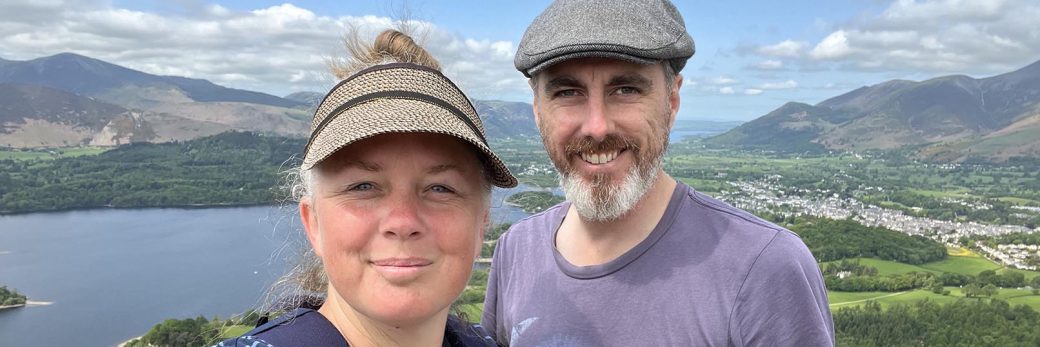
Interlaken (as the name suggests) sits between two lakes. The city is almost completely flat but ringed by mountains, the furthest of which are snow-capped.

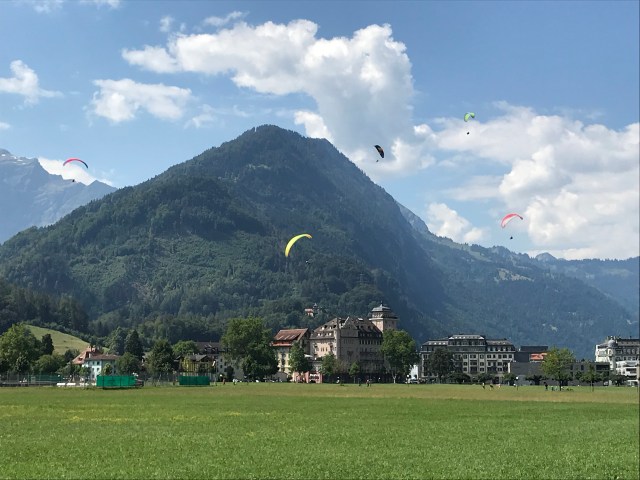
We walked from the train station to our hostel in about 20 minutes and admired all the beautiful wooden houses along the way that had that distinctive Swiss look. We also saw dozens of people paragliding and could hear faint ‘yippeeees!’ Coming from the sky.

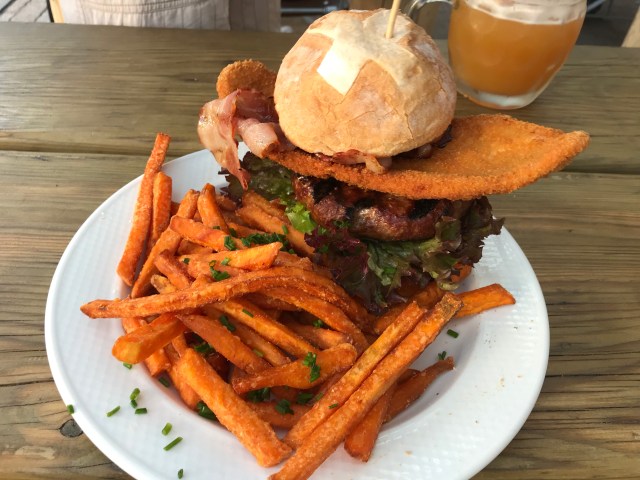
We are staying at the Balmer’s Hostel, the oldest private hostel in Switzerland (or so they say) and our first hostel together for this trip. While I have seen people here who are older than me it’s definitely more of a 20-something party-place with a nightclub on the premises and a bar that is busy all evening. We shared a giant burger and sweet potato fries on our first night. They weren’t cheap but they were good.

We’d hardly been in Switzerland a few hours before Luke remarked that it was my spirit animal (or, you know, country). Clean, well-organised, a recycling bin on every corner, friendly, vegetable gardens in every front yard, fruit trees everywhere and one of my favourite things – natural springs where you can fill your bottle with cold, clear water… it’s heaven.

Paragliders landing on the square in the middle of town.

We’ve only been here a day and we’re wondering when and how we can come back to see it in Winter. One day!

Canada and Alaska: Kamloops

It seems like everyone in Canada is determined to out-nice the last person you met, so I have to tell you how I met Ron.

Halfway through our Rocky Mountaineer voyage we stop for the night at a city called Kamloops. I don’t know why, but I though it would be a tiny, one-horse town in the middle of nowhere. In fact, Kamloops has around one hundred thousand people, a big university, paper mill, and a lovely city centre next to a scenic riverfront. I probably wouldn’t be writing much about it though, if I hadn’t gone for a walk in the late afternoon to keep myself awake so I could get a proper night’s sleep.

I saw a couple of people from the train walking into town (only a couple of blocks from our hotel) so I joined up with them and we walked along chatting and discussing whether dinner was really necessary after being stuffed to the gills on the train.

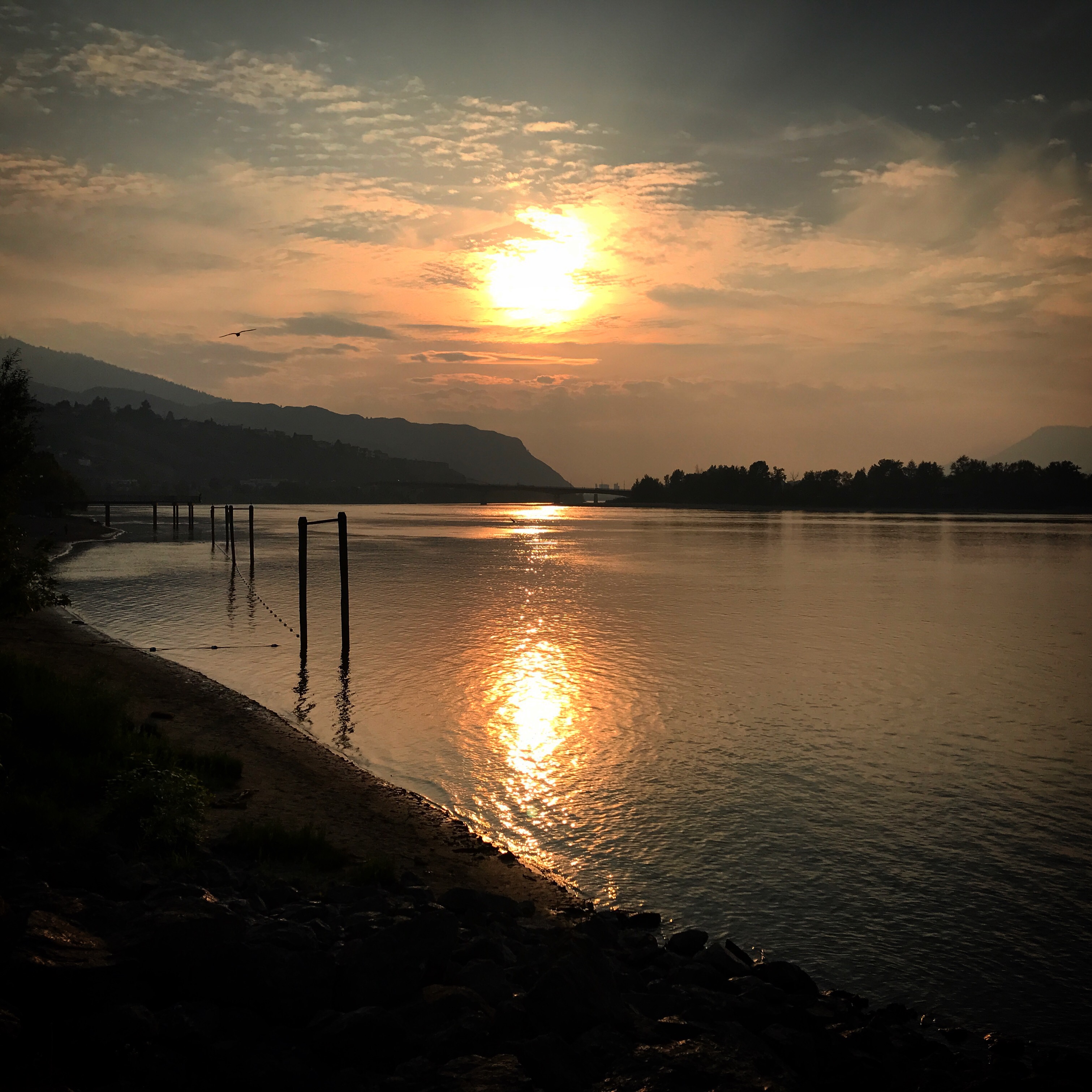
When we got to the edge of the big central park we fell into conversation with a guy named Ron who walked us down to the river to show us some sculptures illustrating the height of past floods. The sun was setting and turning red in the haze from the local fires. The other two wandered off after a bit but I walked around with Ron for an hour, talking about the town and our own travels.

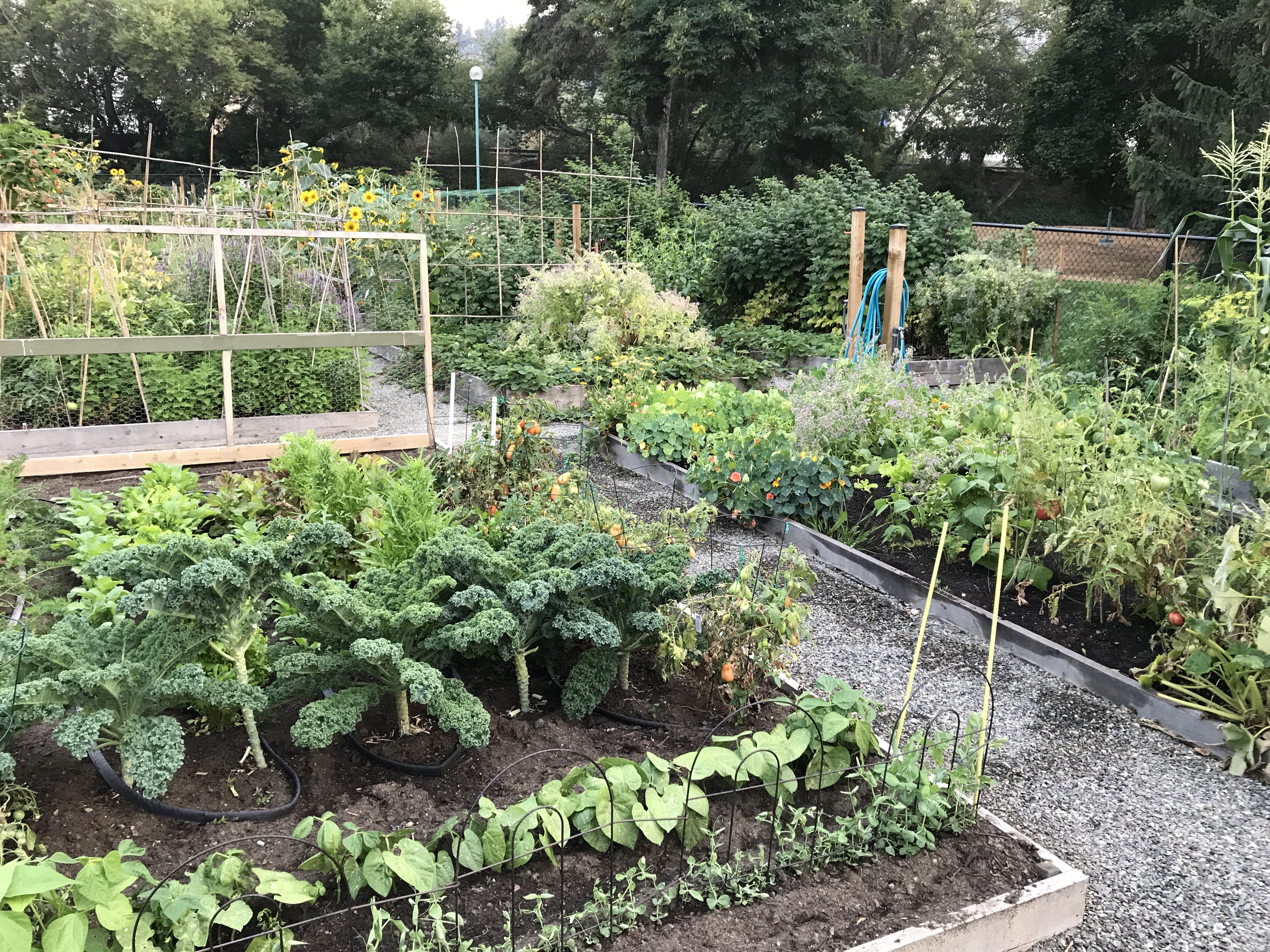
We looked at the river, the gardens, heard a band and looked at some public art, community gardens (a picture for you here, Wendy!) and historical buildings.

Ron had lived in Kamloops for most of his life and his children and grandchild also lived there. He was great! One of the joys of travel is connecting with local people and learning things no tour guide would ever tell you, so if you’re ever in Kamloops and you see a guy who looks about 76, eating a liquorice ice cream and not getting one spot on his tan trousers, call out ‘Ron!’.

You won’t be sorry!

Next: Mum and I tick off a bucket list item and take a ride through Jasper in a Harley Davidson side-car. If you think Mum would look hilarious in leather chaps, you are correct!

Canada and Alaska: I Win a Silver Salmon

I’d read on a blog that the Rocky Mountaineer holds a poetry competition so on the second day I started writing a poem. Halfway through the day nothing had been mentioned so I asked Cleo, one of the staff, if it was happening. She said it only usually happens on the longer routes but I was welcome to get up and read mine. I was immediately filled with terror but I knew I’d regret it if I didn’t, so at the end of the day I got up and read it for our carriage. I got a few laughs for mentioning the things that had been annoying us, like the trees always blocking the view. When I finished they gave me a silver salmon pin and said that if I ever saw anyone wearing one I had to give them the secret salmon handshake, which I will demonstrate for you if I ever see you in person!

There were many stops along the route on the second day to let goods trains pass, so we also had a little quiz sheet that Mum and I also finished first so we really scooped the pool. I never win anything so it was quite thrilling for me!

Here’s the poem I wrote. As you can see, it’s nothing special but I do quite like the way it ends.

Oh Canada, oh Canada

Your home and native land

Is filled with trees, so we ask please,

A chainsaw we demand.

Don’t cut them all, just make them small,

So better views we’ll see,

My camera’s filled with blurs of green,

It looks quite like the sea.

T’wixt train and mountain,

Track and shore,

they block all sight of land

Fine far away, but close I pray

For gaps a camera’s span.

I don’t like to moan, you’ll send me home,

Everything else is grand.

Your food, your smiles, your bear-filled wilds,

Smoked salmon on demand.

Cleo and crew know what to do,

To keep us all well-fed and happy.

Giving us facts and plentiful snacks

Their service is anything but crappy.

We’ve laughed, we’ve snoozed

We’ve barely boozed,

We’ve travelled, young and old,

We’ll come again, just tell us when

On your Rocky Mountain gold

USA: The Desert Eagle

Is it a bird? Is it a plane? No, the Desert Eagle is the train we caught from St Louis to Milwaukee.

I didn’t know quite what to expect from trains in the US. We’d been warned against buses and I’m rather partial to train travel so when Josh suggested catching the train I was keen. I looked at the website and the only thing the train promised was ‘Texas’ sized seats. I think we all know what that means.

We could also check baggage and have it transferred to the Hiawatha – the train that we’d change to in Chicago that continued the journey to Milwaukee. Convenient!

We boarded the train at about 8am and the first thing we noticed was that it was two storey… there’s probably a term for that on trains… double decker? So we sat up the top. The seats were indeed large, and we had a huge amount of legroom. The seats also reclined to an impressive degree and had footrests that popped out and meant that the seats were almost as comfortable as beds. Nice!

I wish I’d thought to take a photo of the seats fully extended.

The train also had a viewing car with windows that wrapped up over the ceiling, a dining car with booths and a kiosk for when the dining car wasn’t open. The selection at both wasn’t large but it was nice to have two options. I got a veggie burger from the kiosk as I hadn’t had breakfast… it was probably the worst meal I’ve had all year and I ended up just eating the bun and a Twix.

The observation car – and as a treat, Luke’s arm!

The train ran on time, and as we got into Chicago it started to snow – the first time Luke had seen falling snow. He was very excited. We had about 90 minutes before the Hiawatha so we ate some food and I tried a bun from Cinnabon, which our friend Megan had recommended. It was a delightfully warm, gooey mess.

The Hiawatha wasn’t as fancy as the Desert Eagle but it was also only a short trip. We arrived in Milwaukee very excited to see my friend Josh and maybe get a chance to play in the snow!

It’s hard to get a photo of snow from a moving train so here’s some of the scenic beauty you can expect around Chicago.

I should add that the whole trip was $50 for each of us – not a bad deal at all for about 8 hours travel in much more comfort that you’d get on a plane.

Portugal: Lagos and Porto (pt 1)

After wasting four nights in Seville we opted for two in Lagos, leaving our options open to stay longer if we liked the place.

Lagos is on the southern coast of Portugal, about five hours by bus from Seville along a rather dull stretch of highway. It’s a little town with an old vibe – and it’s not just the buildings. This is equivalent of Noosa to Europe’s Melbourne. Retirees from England, Germany and other richer countries buy apartments here, or just descend in motorhomes to soak up the sun and bake themselves gently on the golden beaches.

Although how they manage all the stairs I have no idea.

Lagos has a reputation for being a bit of a party town too, with a few nightclubs and bars for the younger crowd but the season was ending and we weren’t really in the mood anyhow. All the restaurants have menus in English and German and there’s a long promenade along the waterfront, lined with palm trees. It’s not a place that screams ‘culture’, but it’s certainly an easy spot to spend a few days. We walked around, ate some Portuguese food but didn’t spend any time on the beach because it was raining on and off the whole time. If it wasn’t for the Portuguese bogans (chavs/rednecks) screaming outside our window each morning and night we’d have had no excitement at all.

We thought about staying longer but the lure of England after months of not speaking the local language was too strong. However, we decided on one more stop – Porto in northern Portugal.

View of Porto, taken from the south side of the river.

We caught 3 trains that took us all the way from south to north. Irritatingly, no one seemed to bother about sitting in their assigned seats. This was only an issue for us because on an overnight bus in Turkey we’d gotten on and someone had been sitting in our seats but the man at the bus terminal had said ‘don’t worry, sit anywhere’. Then we stopped at the next place (very late at night) and the new guy made everyone get up and find their own seats and sit in the right place, which was a pain but should’ve been done at the first stop. Why bother assigning seats if you don’t care where people sit? Assigned seats are much to be preferred though – we caught a Ryanair (world’s most hated airline) flight back from Porto (trust me, if it wouldn’t have cost us several hundred euros more we would’ve happily spent 24 hours training it back to the UK) and watching everyone waiting for their unassigned-seat flight was ridiculous. People are much less relaxed, the flight staff have to cajol idiots who leave spare seats in the middle of rows when it is obvious the flight is full… GAH! I can feel my blood pressure going up just thinking about that company. Don’t get me started on their hidden fees, baggage restrictions, and their sly wallet-gouging techniques. A pox on their house.

But Porto! Porto is beautiful. Really beautiful. And I can say that unequivocally because we saw it in mostly crappy weather and it still made a great impression.

From above Porto reminded me of a very large Cesky Krumlov – all those red roofs and the river flowing through.

For the uninitiated, Porto is home to the drink, port. No surprises there. We went on a tour of a  port house (ignore me calling them wineries on the video when Luke gets around to it) and learned a bit about the history of the drink and the place. Turns out that when England and France went to war several centuries ago and the English could no longer get their hands on French wine, they turned to Portugal to satisfy this need. They discovered that adding brandy to the wine kept it in good condition on its journey across the sea and also produced a much sweeter flavour that appealed very much to the English palate – hence port being a ‘fortified wine’. Only fortified wine from this part of Portugal may be called ‘port’. Many Englishmen moved to Portugal to produce this new drink, hence the fact that the port houses mostly have English names. Some port houses are still owned and run by the same families that started them in the 16th century.

Most people are familiar with ‘ruby’ and ‘tawny’ port but there are also white ports and rosès. We spent our first morning in Porto walking around the port houses and doing tastings. We tried several ruby and tawny ports, two whites and one rosè.

Pronounced “Coe-burns”.

Here’s an article on rosè port with a good description of how it should (could?) be consumed and its history.

We enjoyed all the ports we tried; the whites were comparatively drier and my favourite was the tawny, with its more caramel, rather than fruity flavours. I have tasted port before but it’s certainly not my go-to after dinner drink. This might change now I feel a little more confident and knowledgeable about it.

Some of the more interesting facts I learned on tour was that ruby and tawny ports start off as the same grapes and it is their storage methods which change their taste and appearance. Ruby is stored in large oak barrels and tawny in much smaller ones. It is the greater contact with the oak that changes the tawny into a nice amber colour and the flavours alter as well. The barrels that are used for port are then sent to places like Scotland for whisky production as whisky cannot be aged in a new barrel, it needs the flavours imparted by aged and used oak.

A note on going to Portugal and doing the tastings – we stopped at only three port houses but there are quite a number on the south side of the river, all within a fairly small area. They sit at various levels above the river on a very steep hill. The best idea is to pick whichever you intend to visit, get the cable car up from the riverside or cross the bridge to the highest point and then wander downhill with a map and use a GPS device (like google maps) to give you the best route – there are some paths which cut through blocks and will save you slogging up and down huge hills.

This bridge is most convenient – you can get from the highest point on one side to the highest point on the other side, or cross at the river level.

The tastings were mostly 3 euros for three varieties. Each glass at each house was about 100mls, which looks like a small amount but most definitely is not when you have eight of them – and port is generally around 20% alcohol. My advice is eat a big breakfast (or lunch, depending on when you go) and then you won’t end up with a mid-afternoon hangover. Or you could, y’know, not drink over a bottle of port in a few hours. With all the port houses so close to each other though, it’s very tempting to try to get to as many as possible in one outing. Plus there’s plenty of other things to do and see in Porto, so don’t spend all your time there drinking. Although it is tempting.

Before I move on to other things, here are the places we visited and a few notes.

1. Taylor’s. This port house is fairly far uphill and styles itself as very upmarket (and is – one of the bottles on sale was 2500 euros). However it was still only 3 euro per person for a basic three glass tasting. You can pay more for tastings of their more expensive ports. Their English language tour goes at 2pm and we were too early so we read their little guidebook, tried the port in their very pleasant tasting room and watched a short video on their vineyards and history.

100mls for 100 euro? I’ll have two!

2. Cockburn’s. (Don’t forget, pronounced ‘Coe-burns’.) This port house had a much more casual air than Taylors and we joined a tour that ended up being only six people and took about 20 minutes. We looked at the barrels, a map of the Duoro Valley where the grapes are grown and then tasted three ports. They were nice enough to give us a glass of white for free while we waited for the tour to start. This house also offers picnic lunches in their pretty courtyard under grapevines, but at 15 euro pp we didn’t bother. Plus it was raining so an outside picnic wasn’t all that appealing. The guy who did our tour had excellent English, encouraged questions and the whole experience was excellent value.

Luke and our guide, Sergio.

3. Quevedo. Just back from the waterfront, we weren’t actually planning on having any more port because we felt quite… jolly from the seven glasses we’d already had. However, when we bought tickets for the cable car (5 euro each) up to the bridge it came with a free tasting at this nearby house. So off we went. Quevedo has a large room with explanatory panels around it so you’ve got something to do while you binge-drink. We chose two different ports, including a rosè, and shared – something we should’ve been doing from the start. Their port was ok – the rosè was quite nice and almost strawberry-flavoured. Just a note – their website is a blog and talks about what’s going on with the current harvest, which might interest some of you.

I’m a bit sad that we only did three port houses but if we’d kept going we’d have missed out on many of the other great things Porto has to offer. Which I’ll get to in my next post!

Tawny port barrels.